
Digital marketing has become an important part of how businesses reach customers today. Whether you run a small local business, an online store, or a growing company, most business owners do not have a digital marketing problem. They have a “which one first” problem.
Social media, Google ads, SEO, email, influencers. Every one of them works for somebody. Not every one of them will work for you, and picking the wrong one first is how a marketing budget disappears in three months with nothing to show for it.
This guide covers the seven main types of digital marketing, what each one actually does, how long it takes before you see anything, and how to decide which one to start with.
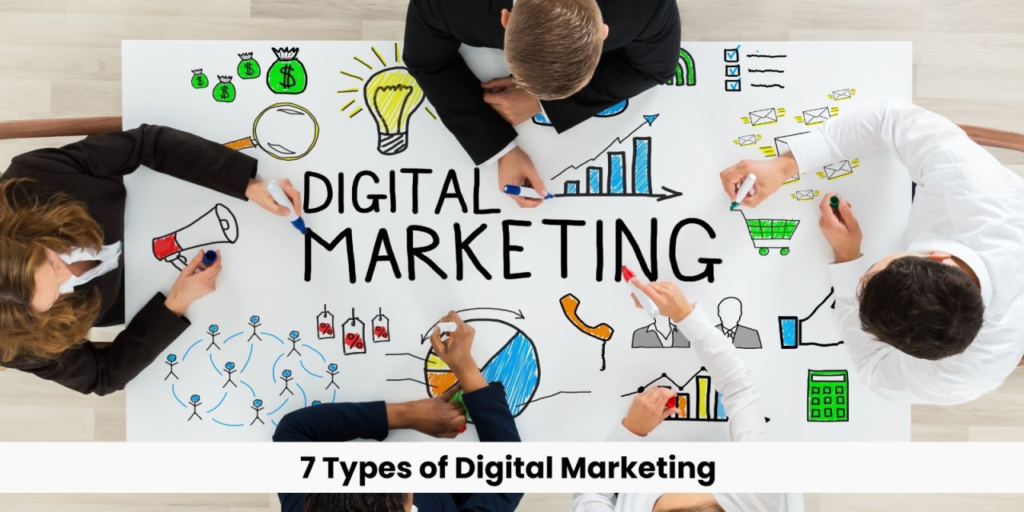
What Is Digital Marketing and How Does It Work?
Digital marketing means promoting your business through the internet and digital channels. It can include social media, websites, search engines, email, online advertisements, influencers, and online marketplaces.
The main goal is simple: reach the right people online and encourage them to take action, such as visiting your website, contacting your business, or making a purchase.
Unlike traditional advertising, digital marketing allows businesses to communicate with customers where they already spend their time online.
The real difference is measurement. A hoarding on the Western Express Highway cannot tell you how many people it sold to. A Google ad tells you exactly how many people clicked, what they bought and what each sale cost you.
Which Are the 7 Types of Digital Marketing?
There are many ways to promote a business online. Here are seven popular types of digital marketing that businesses can use:
| Type | Time to first result | Typical monthly spend | Best for |
|---|---|---|---|
| PPC ads | 24 to 72 hours | Rs 30,000 and up | Products people already search for |
| Social media | 2 to 4 weeks | Rs 25,000 and up | Brand recall, D2C, food, fashion |
| Influencer | 1 to 2 weeks | Rs 20,000 per campaign | Beauty, food, fashion, lifestyle |
| 48 hours | Rs 5,000 and up | Repeat sales from existing buyers | |
| Content | 3 to 6 months | Rs 20,000 and up | High value or considered purchases |
| SEO | 4 to 8 months | Rs 30,000 and up | Steady inbound leads over years |
| Affiliate | 1 to 3 months | Commission only | Ecommerce with healthy margins |
Social Media Marketing
Social media marketing uses platforms such as Instagram, Facebook, LinkedIn, and YouTube to connect with customers. Businesses can share useful information, product updates, offers, videos, and other engaging content.
It is especially useful for building brand awareness and creating a relationship with your audience. For example, It works best when you are selling something people decide with their eyes. Food, fashion, interiors, jewellery, travel. We run accounts for restaurant chains where a single reel of a dish being plated does more for footfall than a month of posts about the brand story.
It works badly when you expect it to close sales on its own. Social media builds recall. Recall makes your ads cheaper later
Content Marketing
Content marketing focuses on creating useful and interesting content for your audience. This can include blog posts, videos, guides, infographics, and social media content.
Good content answers customers’ questions and helps them understand your products or services. Over time, it can also help your business become more visible in search results.
The catch is time. Content marketing is the slowest thing on this list. If you need sales this month, this is not the one to start with.
Email Marketing
Email marketing allows businesses to communicate directly with people who have shown interest in their products or services.
Businesses can use emails to share offers, newsletters, new products, helpful information, and updates. When done properly, email marketing can help turn interested visitors into loyal customers.
One honest note for Indian businesses. Email open rates here sit far below what you read on American marketing blogs. For most of our D2C and retail clients, WhatsApp does the job email is supposed to do, and it does it better. Treat email as the backup channel unless you are selling B2B.
Pay-Per-Click Advertising
Pay-per-click, or PPC, is online advertising where you pay only when someone clicks your ad. Google, Meta, LinkedIn and Amazon all run on this model.
It is the fastest channel on this list. Set up a campaign today and you can have enquiries by tomorrow. It is also the one that stops the moment you stop paying, so treat the spend as rent, not as an investment.
Affiliate Marketing
Affiliate marketing involves working with other people or businesses to promote your products or services. The affiliate receives a commission when their promotion generates a successful sale or action.
This can be a useful option for businesses that want to reach new audiences without handling every promotion themselves.
You pay nothing until a sale happens, which makes it the lowest risk option here. The trade-off is control. You are handing your brand to people who are paid on volume, not on how carefully they represent you.
It fits ecommerce brands with a margin big enough to give away 10 to 20 percent per sale. It does not fit service businesses, premium brands or anyone selling something that needs a conversation before it sells.
Influencer Marketing
Influencer marketing involves working with creators who have an established audience on platforms such as Instagram, YouTube, or other social channels.
An influencer can introduce your product or service to their followers in a way that feels more personal. This approach can work particularly well for fashion, beauty, food, travel, lifestyle, and consumer brands.
The common mistake is chasing follower count. A creator with 15,000 engaged local followers usually outperforms one with 300,000 scattered across the country, and costs a fraction of the price. Ask for engagement rate and audience location before you ask for the rate card.
Search Engine Optimization (SEO)
Search engine optimization, or SEO, helps businesses improve their visibility in search engine results. It involves creating useful content, using relevant keywords, improving website pages, and making the website easier for search engines and visitors to understand.
For businesses that want to attract more people through organic search, SEO is the slowest and the most durable. Expect four to eight months before it moves anything worth reporting. The payoff is that a page ranking on the first page keeps sending enquiries long after you stop working on it, which is the opposite of how ads behave.
Which One Is Right for Fast Sales for Your Business?
If your main goal is to generate sales quickly, some digital marketing methods can help you reach potential customers faster:
- PPC advertising: results in 24 to 72 hours. The fastest way to put an offer in front of people already searching for it.
- Email or WhatsApp: results in 48 hours. Only works if you already have a customer list.
- Influencer marketing: results in 1 to 2 weeks, mostly on the day the post goes live.
- Social media marketing: results in 2 to 4 weeks for offers, longer for brand building.
- SEO: results in 4 to 8 months. Not a fast sales channel. Start it anyway, because in eight months you will wish you had.
If you need sales this quarter, start with PPC. If you have an existing customer list, start with WhatsApp on the same day, because that costs almost nothing and pays back fastest.
Then run SEO and content quietly in the background. Ads buy you time. SEO buys you the years after that.
Why Is Digital Marketing Important for Businesses?
Customers now use the internet to research businesses, compare products, read reviews, and decide what to buy. If your business is not visible online, potential customers may choose a competitor instead.
Before someone calls you, they have already searched your name, read your reviews, looked at your Instagram and compared you with two competitors. All of that happens without you knowing about it. Digital marketing is simply making sure that what they find is good enough to make the call happen.
A good digital marketing business strategy does not always mean using every available channel. It means choosing the channels that match your audience and goals.
Which Type of Digital Marketing Is Right for Your Business?
The right choice depends on your business, audience, budget, and goals.
If you want to build a strong community, social media marketing may be a good starting point. If you want to attract people searching for information, content marketing can help. For quick visibility, PPC advertising may be useful.
An e-commerce business may benefit from Amazon marketing, while brands that work closely with creators may find influencer marketing effective.
In many cases, businesses combine two or more methods rather than depending on just one.
Digital Marketing vs. Online Marketing: What’s the Difference?
They mean the same thing. Digital marketing is the slightly wider term because it technically covers offline digital channels too, like SMS or an ad on a digital screen at the airport.
In practice, if someone says digital marketing and someone else says online marketing, they are both talking about search, social, email, websites and ads.
Do not let an agency charge you differently for the same work under two names.
How Can You Measure Your Digital Marketing Results?
You do not need an agency to start. You need one when the work stops fitting into the hours you have.
The honest test is this. If one person in your team is running ads, writing posts, replying to comments and doing SEO, none of those four are being done properly. That is the point where an agency pays for itself.
Before you sign with anyone, ask them for two things: a client in your industry you can call, and what they would do in the first 30 days. Anyone who cannot answer the second one is guessing.
One of the key benefits of digital marketing is the ability to measure and track your results. Depending on your goals, you can measure website visits, leads, enquiries, sales, social media engagement, email responses, and advertising performance.
For example, if your goal is to generate enquiries, focus on leads rather than simply counting social media likes.
Pick three numbers and check them every month. For most businesses those three are: how many enquiries came in, what each enquiry cost you, and how many of them turned into paying customers.
Likes, reach and followers are worth watching. They are not worth reporting to yourself as results.
So Where Should You Start?
If you need sales in the next 90 days: PPC first, then WhatsApp to your existing list.
If you are building something for the long run: SEO and content from day one, ads on top once the site converts.
If nobody knows your name yet: social media and influencers, then ads once people recognise you.
Most businesses need two of these running together, not all seven.
Inflex Media is a digital marketing agency in Andheri West, Mumbai. We run social, performance, SEO, content and influencer campaigns for brands across India, the UAE and Singapore. If you want a straight answer on which of the seven your business should start with, send us your website and we will tell you what we would do in the first 30 days.